
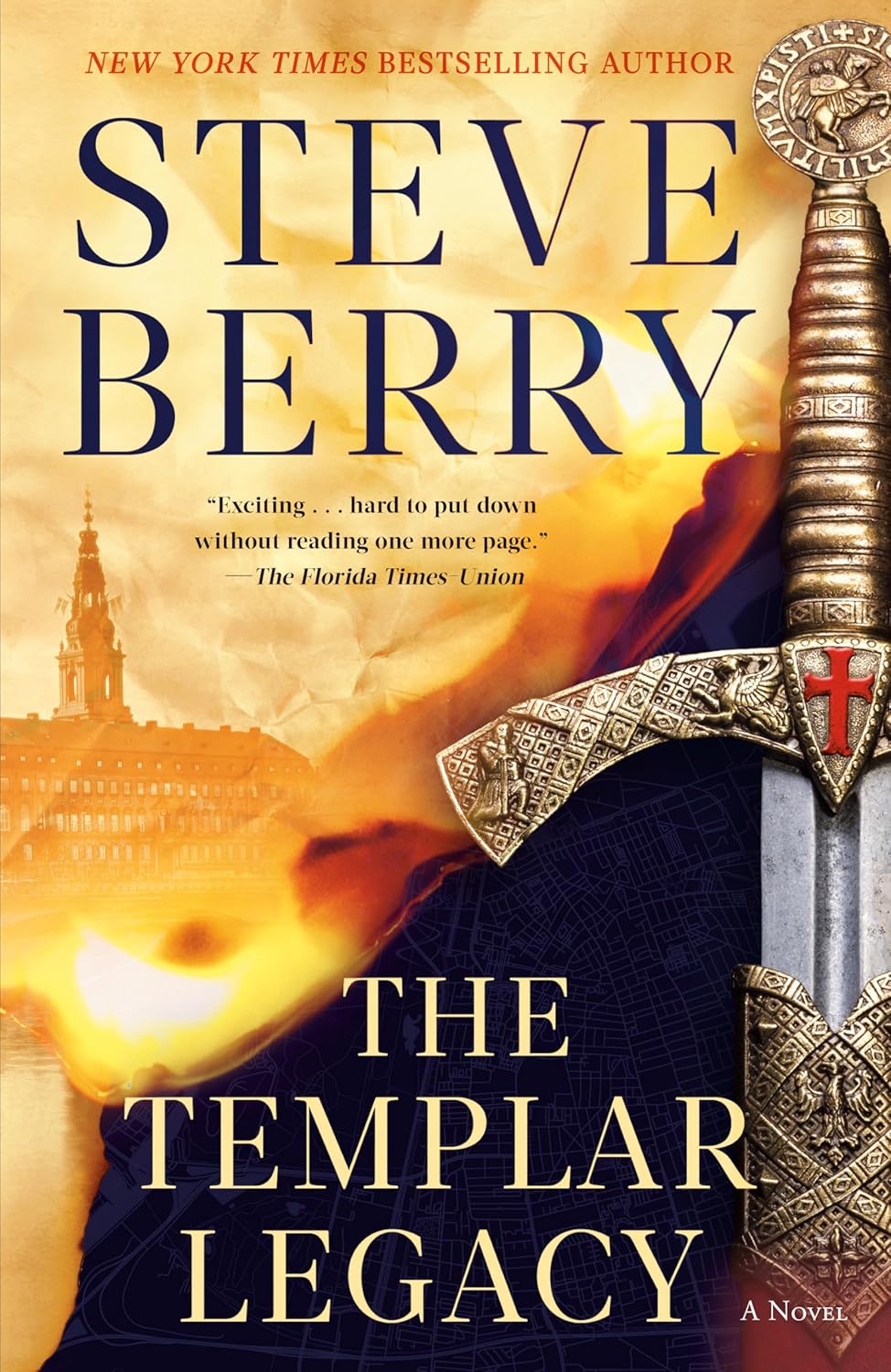
I’ve always had this nagging suspicion that the best history is the stuff they didn’t want to write down. You know the feeling—you’re looking at a dusty monument or an old map, and you just know there’s a layer of grime and secrets underneath that the tour guide is skipping over. That’s usually the headspace I’m in when I pick up a thriller that claims to “unlock” the secrets of the Knights Templar. We’ve all seen the tropes before, thanks to a certain blockbuster from the early 2000s, but Steve Berry’s The Templar Legacy felt different to me when I finally cracked the spine of this hardcover edition. It wasn’t just looking for a “gotcha” moment; it felt like it was trying to reconstruct a puzzle that had been shattered for seven centuries.
But let’s be real for a second. Is The Templar Legacy worth reading today, or has the “historical conspiracy” genre finally run out of steam? After spending some quality time with Cotton Malone in the streets of Copenhagen and the mountains of France, I’ve got some thoughts that might go against the grain of the usual five-star hype.
The Cotton Malone Introduction: Not Your Average Action Hero
What surprised me first wasn’t the Templars themselves, but the protagonist. We’re introduced to Cotton Malone, a man who has traded the high-stakes world of government intelligence for the quiet life of an antiquarian book dealer in Denmark. I have to admit, I loved that. There’s something inherently grounded about a hero whose primary weapon—at least initially—is a deep knowledge of rare manuscripts rather than just a quick trigger finger.
It felt unusual to see a character so genuinely reluctant to get back into the game. Usually, these thriller leads are “retired” but secretly itching for a fight. Malone feels like he actually enjoys his bookshop. When his former boss, Stephanie Nelle, shows up, the tension isn’t just about the mission; it’s about the intrusion of a violent past into a peaceful present. That friction gave the opening chapters a weight that I wasn’t expecting. It made me care about Malone’s peace of mind before I even cared about the Templar treasure.
Pacing: The Slow Burn vs. The Sprint
If you’re coming into this expecting a 300-page sprint where things explode every ten minutes, you might find yourself checking the page count. Berry takes his time. The narrative moves through a series of historical breadcrumbs that require the reader to actually think. I found the pacing to be a bit of a double-edged sword. On one hand, the intellectual rigor is refreshing. On the other, there were moments in the middle of the book where the weight of the historical exposition felt like it was slowing the momentum to a crawl.
What I found interesting, though, was how Berry uses the setting. This isn’t just a backdrop. Whether it’s the intricate geography of Rennes-le-Château or the cold canals of Copenhagen, the locations feel like characters. There’s a specific kind of atmosphere here—damp, ancient, and slightly claustrophobic—that sets it apart from the sunny, high-tech thrillers of the James Patterson variety. This is a “boots on the ground” kind of story where you can almost smell the old paper and the mountain air.
Challenging the “Dan Brown” Comparison
It’s the elephant in the room, isn’t it? Every time a book mentions the Templars, critics scream, “It’s the next Da Vinci Code!” But having sat with The Templar Legacy, I’d argue that’s a lazy comparison. While Dan Brown focuses on the “what if” of religious history, Berry seems more interested in the “how it survived.”
What might not work for everyone is the granularity of the Templar lore. Berry gets into the weeds of the Order’s downfall in 1307, the trials, and the specific logistics of how a massive organization could hide its assets. Some readers might find this “too academic,” but for me, it added a layer of credibility. It felt less like a fantasy and more like a forensic reconstruction. However, I’ll be honest: there’s a section involving the “Great Devise” that left me a bit cross-eyed. I had to go back and re-read a few pages to make sure I followed the logic of the puzzle. It’s rewarding, but it’s definitely work.
The Emotional Impact: More Than Just a Chase
I didn’t expect to feel much for the antagonists in this book, but there’s a certain tragic quality to the quest for the Templar secret. It’s about more than just money or power; it’s about the validation of a legacy. The emotional stakes for Stephanie Nelle, in particular, felt deeply personal. Her connection to the mystery isn’t just professional, and that added a layer of vulnerability to the story that kept it from feeling like a cold, mechanical thriller.
That being said, there were times when the dialogue felt a bit “as you know, Bob.” You know the type—where two experts explain things to each other that they clearly already know, just so the reader can be caught up. It’s a common sin in this genre, but it did pull me out of the moment once or twice. I wanted the characters to breathe a little more naturally instead of acting as mouthpieces for historical research.
Who Should Read This Book? (And Who Should Skip It)
I think it’s important to be honest about who this is for. If you’re the type of person who pauses a movie to look up the real-life history of a castle on Wikipedia, you are going to love this. It’s a book for the “intellectual adventurer.”
You should read The Templar Legacy if:
- You enjoy thrillers that prioritize research and historical accuracy (or at least plausible historical theories).
- You like a protagonist who is competent but weary, someone who uses his brain as much as his brawn.
- You’ve always been fascinated by the Knights Templar but wanted something with more grit and less “Indiana Jones” camp.
- You appreciate European settings that feel authentic and lived-in.
You might want to skip this if:
- You prefer “unputdownable” books that you can read in a single four-hour sitting. This one requires a bit more stamina.
- You’re tired of the “ancient secret” trope and want something entirely modern.
- You get frustrated by long passages of historical backstory or architectural descriptions.
The Final Verdict: Is The Templar Legacy Worth Reading?
When I finished the last page, I didn’t feel like I’d just eaten a piece of literary candy. It felt more like a full meal—one that was maybe a bit too heavy on the side dishes, but satisfying nonetheless. Steve Berry has a way of making the 14th century feel like it’s just around the corner, and Cotton Malone is a guide I’m willing to follow into future installments.
My conclusion is a bit nuanced. It isn’t a perfect book; the middle section sags slightly under its own weight, and the villain’s motivations can feel a bit “classic thriller” at times. But as a piece of historical fiction disguised as a contemporary thriller, it’s remarkably effective. It treats the reader like someone who is capable of handling complex ideas, and in a world of “dumbed-down” bestsellers, that counts for a lot.
It’s not a “must-read” for every person on the planet, but for a specific kind of curious mind, it’s a journey that leaves you looking at old churches and dusty archives a little bit differently. And really, isn’t that what we want from a book like this? To feel like the world is just a little bit more mysterious than we thought?
“Enjoyed this review? Discover more in our Mystery Reviews section.”


