
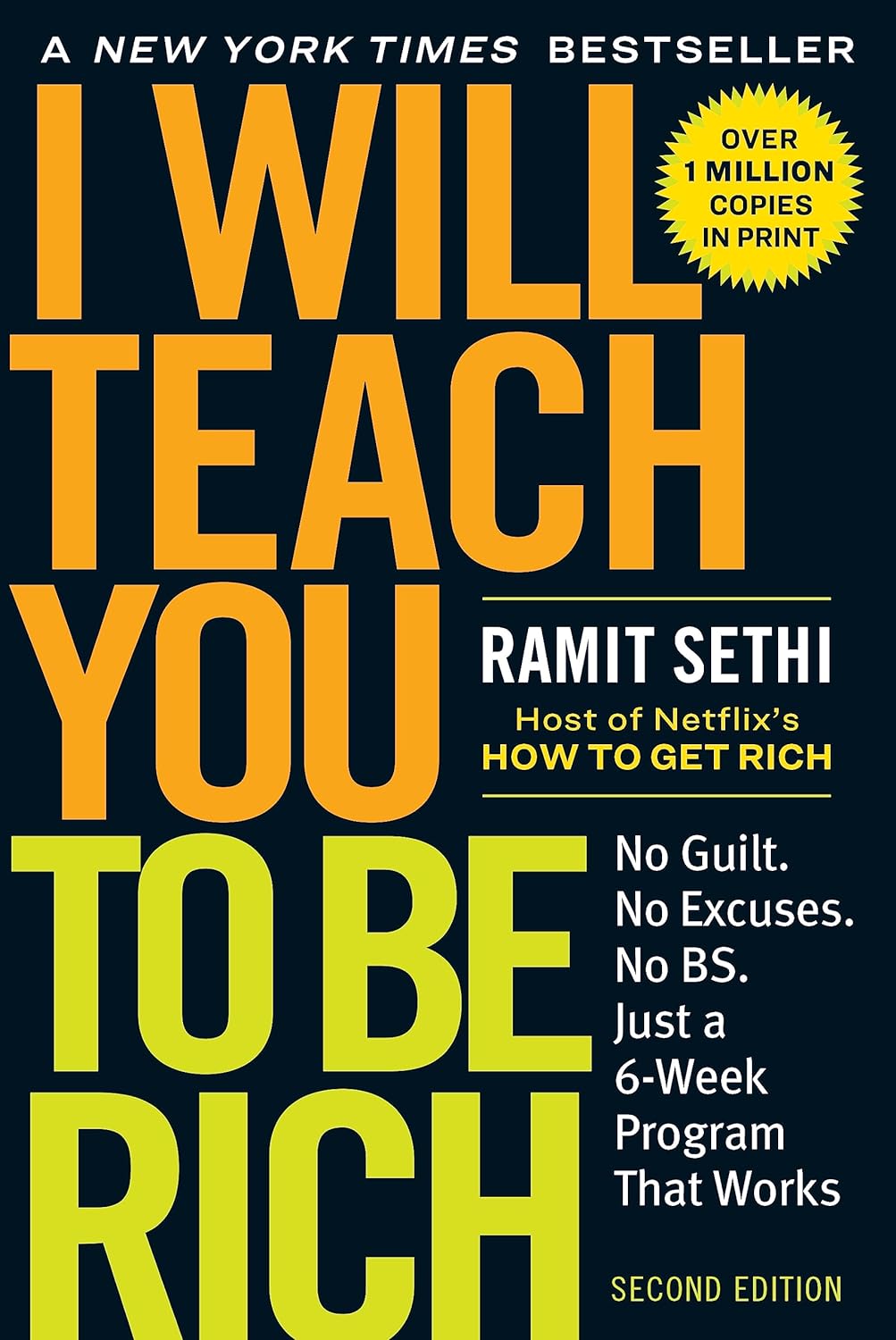
In a world saturated with financial advice, from the overly cautious to the wildly speculative, finding a voice that cuts through the noise can feel like striking gold. For countless individuals seeking a clear path to financial independence, Ramit Sethi’s I Will Teach You to Be Rich has emerged as just that: a straightforward, no-nonsense guide that challenges conventional wisdom and empowers readers to take decisive action. This isn’t your grandparent’s staid finance textbook; it’s a vibrant, sometimes provocative, and undeniably effective roadmap to building wealth and designing a life of abundance.
When I first picked up I Will Teach You to Be Rich, I was, like many, tired of the endless debates about latte factors and extreme frugality. I wanted practical, actionable advice that didn’t demand I sacrifice every ounce of joy in the pursuit of saving a few dollars. What I found in Sethi’s work was a refreshing perspective: one that champions conscious spending, strategic automation, and a deep understanding that money is merely a tool to live your “Rich Life.” This comprehensive I Will Teach You to Be Rich book review will delve into the core tenets that make this book a perennial bestseller and a transformative force in personal finance.
Unpacking Ramit Sethi’s Philosophy: More Than Just a Budget
Ramit Sethi, a Stanford-educated entrepreneur and personal finance expert, has built an empire around the concept of a “Rich Life.” His core philosophy, laid out meticulously in I Will Teach You to Be Rich, isn’t about penny-pinching or extreme austerity. Instead, it’s about optimizing your finances to spend extravagantly on the things you love, while ruthlessly cutting costs on the things you don’t. This nuanced approach recognizes that true wealth isn’t just about accumulating money, but about using that money to create a life aligned with your deepest values. This is a fundamental shift from the restrictive budgeting advice prevalent in much of the personal finance world, making this I Will Teach You to Be Rich book review particularly relevant for those seeking a different approach.
The book is structured around a six-week program, though Sethi emphasizes that the principles are timeless and can be implemented at your own pace. His core tenets revolve around four pillars: conscious spending, automation, intelligent investing, and identifying “Big Wins.” Unlike many financial gurus who preach a one-size-fits-all approach, Sethi encourages readers to define their own “Rich Life”—whether that means traveling the world, starting a business, or simply enjoying guilt-free dinners out. This personalization is a powerful motivator, transforming the daunting task of financial planning into an exciting journey of self-discovery.
One of the most profound takeaways from I Will Teach You to Be Rich is the idea that “getting started is more important than being an expert.” Sethi constantly reiterates that perfection is the enemy of good when it comes to money. Far too many people get stuck in analysis paralysis, endlessly researching the “best” investment or savings account, only to do nothing at all. Sethi’s message is clear: implement an 85% effective plan now, rather than waiting for a 100% perfect plan that never materializes. This emphasis on action over endless research sets the book apart.
The Language and Narrative Style: Engaging, Direct, and Actionable
If you’ve ever found traditional finance books dry, dense, and full of impenetrable jargon, I Will Teach You to Be Rich will be a breath of fresh air. Sethi’s writing style is anything but conventional. He employs a casual, often humorous, and unapologetically direct tone that feels more like a candid conversation with a financially savvy friend than a lecture from a stuffy academic. He doesn’t shy away from calling out “financial gurus” who promote overly complicated or fear-mongering advice, and he’s not afraid to tell you when you’re making excuses.
His language is peppered with relatable anecdotes, analogies, and a healthy dose of wit that keeps the reader engaged, even when discussing seemingly mundane topics like bank fees or credit card optimization. This directness can be a double-edged sword; some readers might find his “tough love” approach a bit abrasive, but for others, it’s precisely the kick in the pants they need. Sethi’s narrative style is less about theory and more about practical application, often providing scripts for phone calls with banks or step-by-step guides for setting up automated systems. This actionable focus is a cornerstone of this I Will Teach You to Be Rich book review.
For instance, Sethi doesn’t just tell you to negotiate bank fees; he gives you the exact phrases to use: “Hi, I’ve been a loyal customer for X years, and I’m calling about the monthly maintenance fee on my checking account. I was wondering if there’s anything you can do to waive that fee for me?” This level of specificity removes the guesswork and makes it incredibly easy for even the most financially intimidated individual to take action. The book’s narrative emphasizes that financial mastery isn’t about being inherently good with numbers, but about setting up systems that work for you, consistently, over time.
A Deep Dive into the Core Strategies
I Will Teach You to Be Rich is built upon a foundation of interconnected strategies, each designed to simplify personal finance and accelerate wealth building. Understanding these components is crucial for any comprehensive I Will Teach You to Be Rich book review.
Automating Your Finances: The Set-It-and-Forget-It Approach
One of Sethi’s most revolutionary and often-praised concepts is the power of automation. He argues that willpower is a finite resource, and relying on it to manage your money daily is a recipe for failure. Instead, he advocates for setting up a “money flow” where your income is automatically directed to savings, investments, and bill payments as soon as it hits your account.
This involves:
- Automatic transfers to savings accounts: Designating a specific amount or percentage of your income to be moved to a high-yield savings account on payday.
- Automated investment contributions: Setting up recurring transfers to your retirement accounts (401k, Roth IRA) and brokerage accounts.
- Automated bill payments: Ensuring all your bills, especially credit card payments, are paid on time to avoid fees and build credit.
The beauty of automation is that it removes the emotional element from financial decisions. Once set up, your money is working for you without daily intervention. As Sethi famously states, “Once you set up your automated financial system, it will continue to work for you, day in and day out, whether you’re working, sleeping, or on vacation.” This hands-off approach ensures consistency, which is paramount for long-term wealth accumulation.
The Power of Conscious Spending: Guilt-Free Spending on What You Love
In stark contrast to the “cut every expense” mentality, Sethi introduces the concept of Conscious Spending. This isn’t about creating a restrictive budget that makes you miserable; it’s about identifying what truly brings you joy and spending lavishly on those areas, while mercilessly cutting back on everything else.
To implement Conscious Spending, Sethi suggests:
- Tracking your current spending for a month to understand where your money is actually going.
- Identifying your “money dials”: These are the areas where you genuinely love to spend money (e.g., travel, eating out, hobbies, designer clothes).
- Allocating funds: Creating a plan where a certain percentage of your income goes to fixed costs, investments, savings goals, and then your “guilt-free spending” on those money dials.
This approach acknowledges human nature. We aren’t robots, and complete deprivation leads to burnout and rebellion. By consciously deciding where your money goes, you eliminate guilt and gain control. It’s about being “frugal, not cheap.” A cheap person cuts indiscriminately, often to their detriment or the detriment of others. A frugal person, in Sethi’s terms, is strategic, making smart trade-offs to maximize their “Rich Life.” This nuanced view is a highlight of any robust I Will Teach You to Be Rich book review.
Smart Investing for the Long Term: Demystifying the Stock Market
For many, the world of investing seems complex and intimidating. Sethi demystifies it, advocating for a simple, passive, long-term approach that focuses on low-cost index funds and exchange-traded funds (ETFs). He stresses that trying to “beat the market” by picking individual stocks or timing fluctuations is a fool’s errand for most people.
Key investing takeaways include:
- Start early: The power of compound interest means that every year you delay investing costs you significantly.
- Invest in low-cost index funds: These diversified funds automatically track a market index (like the S&P 500) and have significantly lower fees than actively managed mutual funds.
- Diversify: Don’t put all your eggs in one basket.
- Ignore the noise: Avoid financial news that encourages panic selling or chasing hot stocks. Investing should be “boring.”
Sethi simplifies complex topics like 401(k)s, Roth IRAs, and brokerage accounts, providing clear instructions on how to set them up and contribute consistently. He emphasizes the importance of maximizing employer matching contributions in a 401(k) as “free money” – an indispensable piece of advice for anyone beginning their investment journey. This clarity on investing is a strong point in this I Will Teach You to Be Rich book review.
Big Wins: Beyond the Daily Grind
While automation and conscious spending optimize daily finances, Sethi also introduces the concept of “Big Wins”—significant actions that have a disproportionately large impact on your financial life. These aren’t about saving a few dollars on a coffee; they’re about making moves that can save or earn you thousands.
Examples of Big Wins include:
- Negotiating your salary: A small percentage increase in salary compounds over your career into hundreds of thousands of dollars.
- Optimizing large expenses: Negotiating down interest rates on loans, refinancing mortgages, or finding better deals on insurance.
- Eliminating high-interest debt: Aggressively paying off credit card debt, which can be a massive drain on your financial resources.
- Starting a side hustle: Finding ways to generate additional income outside your primary job.
Sethi emphasizes that these “Big Wins” often require a bit of effort upfront but yield massive returns over time, freeing you to focus on your “Rich Life.” He encourages readers to proactively seek out these opportunities rather than passively accepting the status quo.
Strengths of ‘I Will Teach You to Be Rich’
This I Will Teach You to Be Rich book review wouldn’t be complete without highlighting its many strengths. Perhaps its greatest asset is its unwavering practicality. Sethi doesn’t just offer theoretical concepts; he provides concrete, actionable steps that anyone can follow. The book is filled with screenshots, exact scripts, and clear instructions, making it incredibly easy to implement the advice immediately. It takes the guesswork out of personal finance, empowering readers to move from intention to action.
Another significant strength is its engaging and accessible tone. As discussed, Sethi’s informal, humorous, and direct writing style makes a topic that can often be intimidating or dull feel approachable and even exciting. He speaks to readers as equals, not as an aloof expert, fostering a sense of camaraderie and motivation. This human-like voice is a refreshing departure from the dry prose found in many financial guides.
The book’s focus on automation is truly groundbreaking for many. By advocating for a “set-it-and-forget-it” system, Sethi tackles one of the biggest challenges in personal finance: consistency. It acknowledges that human willpower is fallible and provides a robust framework to overcome procrastination and laziness. Once automated, the system works tirelessly, ensuring progress even when life gets busy.
Furthermore, I Will Teach You to Be Rich places a healthy emphasis on the psychology of money. Sethi understands that financial decisions are often driven by emotions, not logic. He addresses common money hang-ups, fears, and excuses head-on, encouraging readers to confront their beliefs about money and design a financial life that truly serves them. This psychological insight elevates the book beyond a simple “how-to” guide.
Finally, the concept of the “Rich Life” is a powerful differentiator. It encourages readers to move beyond merely saving for retirement to actively defining and pursuing a life of purpose and joy now, financed by smart financial habits. This aspirational element provides a compelling reason to engage with the material and transforms financial planning from a chore into a means to achieve personal fulfillment.
Potential Weaknesses and Criticisms
While I Will Teach You to Be Rich is undoubtedly impactful, no book is without its criticisms. One common point raised in other I Will Teach You to Be Rich book review analyses is that the book’s advice, particularly the “Conscious Spending” and investing sections, might be less impactful for those in dire financial situations. If someone is struggling with overwhelming debt or living paycheck to paycheck, the idea of “guilt-free spending” might feel out of reach, and the automation of investments might seem premature. While Sethi does cover debt repayment, his focus is more on optimizing existing finances rather than providing a rigorous “debt snowball” or “debt avalanche” strategy for extreme cases.
Another criticism is that some of the advice, particularly around credit cards and basic investing, might feel rudimentary to those who are already financially literate or experienced investors. For such readers, the initial chapters might be too basic, though the sections on “Big Wins” and advanced automation could still offer value.
The book’s direct and sometimes aggressive tone can also be a turn-off for some readers. While many appreciate Sethi’s no-BS approach, others find it off-putting or condescending. His frequent use of phrases like “Listen up, crybabies” or his dismissal of “financial porn” might rub some the wrong way, making it harder for them to connect with the material.
Lastly, some readers might find the emphasis on USA-specific financial products (like 401(k)s and Roth IRAs) a limitation if they live outside the United States. While the core principles of automation, conscious spending, and index fund investing are universal, the specific account types and tax implications will differ in other countries, requiring international readers to adapt the advice.
My Personal Takeaway from This I Will Teach You to Be Rich Book Review
Before reading I Will Teach You to Be Rich, my approach to personal finance was a hodgepodge of inherited wisdom and fear-driven impulses. I diligently tracked every penny, often feeling guilty about small indulgences, and saw investing as a mysterious, high-stakes game only for the elite. Sethi’s book completely reshaped my perspective.
The most transformative lesson for me was the concept of Conscious Spending. It wasn’t about deprivation but about intentionality. The idea that I could spend lavishly on things I genuinely loved, like quality coffee and travel, provided immense relief and empowerment. It taught me to identify my true values and align my spending with them, rather than simply reacting to consumerist pressures or societal expectations. This singular shift made personal finance feel less like a chore and more like a tool for living a fulfilling life.
Automating my finances, once a daunting prospect, became surprisingly simple after following Sethi’s step-by-step instructions. Setting up automatic transfers to my investment accounts and bill payments meant I no longer had to rely on willpower. The money simply moved where it needed to go, allowing me to focus my mental energy elsewhere. It felt like a weight lifted off my shoulders, providing a sense of calm and control I hadn’t experienced before. This automation became a cornerstone of my financial peace, directly influenced by this I Will Teach You to Be Rich book review’s subject.
Sethi’s approach to investing, stripped of all the unnecessary complexity, was also incredibly liberating. His insistence on low-cost index funds and a “boring” long-term strategy resonated deeply. It demystified the stock market for me, replacing fear with a quiet confidence that my money was working effectively without constant tinkering or expensive expert advice. I realized that consistency and patience were far more powerful than trying to be clever or predict market movements.
In essence, I Will Teach You to Be Rich didn’t just teach me how to manage money; it taught me how to think about money as a tool for a bigger, richer life. It gave me permission to enjoy my money without guilt, as long as I had a robust, automated system in place.
What Other Readers Are Saying: A Glimpse into Public Opinion
A quick glance at platforms like Amazon and Goodreads reveals a widespread and largely positive reception for I Will Teach You to Be Rich, though with some recurring points of critique. Many readers echo my own experience, calling the book “life-changing” and “a game-changer” for their financial well-being. They praise its “straightforward, no-BS approach” and its ability to break down complex topics into easily digestible and actionable steps.
One common sentiment is that the book is “perfect for beginners” or those who feel overwhelmed by traditional financial advice. Readers frequently mention how Sethi’s humor and direct style kept them engaged where other books had failed. Comments like, “I’ve tried reading other finance books, but this is the first one that actually made sense and motivated me to act!” are ubiquitous. Many appreciate the “tough love” and candidness, finding it refreshing and effective.
Positive reviews often highlight the success stories derived from applying Sethi’s methods: “Thanks to this book, I finally automated my investments and saw my net worth grow significantly in just a few years,” and “The conscious spending plan completely changed how I view my money – no more guilt about my hobbies!” The emphasis on automation and the “Rich Life” concept are frequently cited as key benefits.
However, some readers, particularly those already well-versed in personal finance, mention that some of the advice is “too simplistic” or “basic”. There are also recurring comments about Sethi’s tone being “a bit aggressive” or “condescending” for some tastes, though many acknowledge that this is part of his brand and ultimately serves to motivate. A few international readers note the book’s “US-centric examples” as a minor drawback, requiring some adaptation for non-US audiences. Despite these minor criticisms, the overwhelming consensus, as reflected in this I Will Teach You to Be Rich book review and countless others, is that the book is an invaluable resource for anyone looking to take control of their finances and build a truly rich life.
Conclusion
In the vast landscape of personal finance literature, I Will Teach You to Be Rich by Ramit Sethi stands out as a beacon of clarity, practicality, and refreshing candor. It’s not just a book about money; it’s a manifesto for living a life intentionally designed around your values and goals. Sethi empowers readers to move beyond passive worrying about money and into active, automated financial mastery.
Whether you’re just starting your financial journey, feeling overwhelmed by conflicting advice, or simply looking to optimize your existing habits, this book offers a robust and actionable framework. It will challenge your assumptions about money, encourage you to think bigger, and provide you with the tools to build a financial system that works for you, automatically.
If you’re ready to stop making excuses and start building your financial future, I wholeheartedly encourage you to pick up a copy of I Will Teach You to Be Rich. It’s more than just a book; it’s an investment in your future self, a blueprint for financial freedom, and a guide to living your own unique “Rich Life.” This I Will Teach You to Be Rich book review aims to highlight why this book continues to resonate with so many. Go ahead, read it, implement its wisdom, and prepare to transform your relationship with money forever.
“Enjoyed this review? Discover more in our Business & Money Reviews section.”


